

Highlighting Katie Anderson
The next person I'm thrilled to highlight for you is Katie Anderson. Katie's life work embodies what it means to show up as your authentic self, care for others, and move forward with purpose and precision. I love any opportunity to chat with her because she is absolutely present.
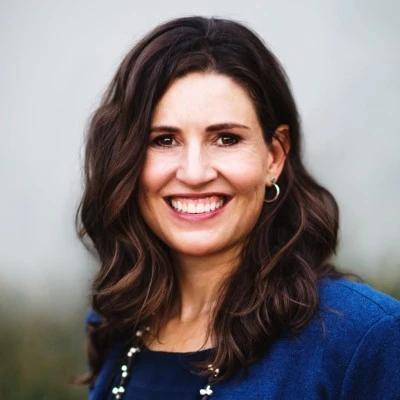
Katie is the author of the award-winning book Learning to Lead, Leading to Learn and the host of the transformational leadership podcast Chain of Learning®, where she shares how to build a culture where everyone is both a learner and a leader, strengthening capability, confidence, and connection across all levels. As a consultant, the way she guides leaders is rooted deeply in humanity, creating meaningful transformation through curiosity, care, and courage.
Katie's work is rooted deeply in what she calls the "Chain of Learning", the idea that we're all both learners and leaders, and the strength is in the bond between us. Katie and I jumped on a call to see what she thinks about connection, reciprocity, and the relationships that matter most.
On Connection
Annie: You're a natural connector and someone who thinks about bringing people together to create successful outcomes. What's one thing that comes naturally to you and one thing that you have to work hard at to make this happen?
Katie: I've always been a natural connector. I've lived around the world in seven different countries. I've always sought out relationships and connection, and I've stayed connected with people. I can't explain it; it's so core to who I am. But connection for me isn’t about “networking” from a transactional perspective. It comes from a genuine curiosity and desire to learn from and help each other. I’ve come to understand that my purpose is to connect the hearts and minds of people around the world so that – together – we can make it better.
I think it's why I love creating the Japan Leadership Experience immersive learning program, based on the relationships and insights I gained from living in Japan a decade ago. It’s the manifestation of my purpose: people, learning, connection, and international experience. Since 2018, over 160 global leaders have participated in this transformative journey – each cohort brings me energy because of the connections, relationships, and learning.
What is hard for me about connecting? The biggest challenge is time! I really want to not just connect, but to stay connected – with everyone. So I have to balance the doing of connection with the experience of life as well. But I believe you can also be connected with people and not talk for a long time. It's about the depth and realness of the relationship you've built.
Annie: Reciprocity doesn't always look like an apples to apples trade in every relationship. What does reciprocity look like in your most valuable professional relationships?
Katie: It goes back to this Chain of Learning concept. We can be giving and receiving different things from the relationship. You can be the learner, the leader, the coach, the client, the parent, the child. You both give and receive different things in the relationship, but you're also both growing and learning from that experience as well. The strength in a chain is the connection between the links.
As that relates to my professional clients, I'm always learning something new from working with them. I might share some of my lived expertise or knowledge, holding the space for their learning, and at the same time, I'm learning how to frame something differently, show up more fully, help that individual situationally. I genuinely develop relationships that transcend the transactional client engagement – it’s more than the goal we accomplish, it’s the relationship that is formed. I can't tell you how many past clients are friends now, too.
And that's what Isao Yoshino, the subject of my book Learning to Lead, Leading to Learn, said that joining Toyota was for him -- he valued that chain of learning that everyone was there to help each other learn and grow, and saw the opportunity to learn and grow through that helping, no matter role or title.
Align
Annie: Do you have 2-3 people who advocate for you when you're not in the room? How did those relationships develop?
Katie: When you develop genuine connection and are helpful for people in a way that's based on caring and humility and curiosity, they will advocate for you. Most of my work comes from referrals from past relationships or because people connect with me – from my book, to my podcast, to my LinkedIn posts and videos. People pay it forward; they tell other people about the great experiences they've had and it’s a virtuous cycle.
I would say it's even more than two to three people who advocate for me. If you've done good work, helped someone in a genuine way, and created real human relationships, that's where the referral comes from. Help people see something with an aha moment or a new framing. Leaders often say that concepts have "dropped from the head to the heart" when working with me. I would hope and want all my clients to have such a positive experience that they become positive advocates and tell others, "You have to work with Katie or go on her Japan program."
Partner
Annie: How have peer relationships changed how you think, not just what you know?
Katie: The power of peers is that you can really share the nitty-gritty of what's going on for you right then in the moment. I have a few different peer networks. For example, I have one peer network of eight other women, all independent consultants in a similar-ish field, and we get together, whoever can join, for a Zoom call every other week. It's just great to be able to talk about what's going on in your business or what's going on in your thinking or just chat about life as well. Being able to share freely, share insights, and lift each other up is the power of peer relationships.
Guide
Annie: You don't have to be a manager to guide someone, but you do guide a lot of people through the work that you do. Is there anyone that looks to you for guidance and leadership? If so, what do they do that makes you proud?
Katie: One of the core ways I work with clients is as a guide – either a trusted advisor helping them think through their leadership behind the scenes or as a source of learning and inspiration through workshops, coaching, and speaking. The foundation of all of this is to help leaders have the same aha moments I had earlier in my career – the identity shift from being the one with the answers or the person who had to do it all. We often default to telling or doing from a place of caring, but then we end up carrying – owning – the responsibility for all the problems and work. I call this the Doer Trap.
Our role shifts as we move into people leadership – whether as a team leader, a manager, or executive – or even as a parent. It’s about creating awareness of when we are flipping from providing support to controlling the outcome or overstepping ownership – and having the opposite impact than we really want to. This is the essence of the new book I’m writing right now.
What I'm really proud of is when people tell me, "Wow, asking questions is my superpower," or, "I don't have to be the one with all the answers." I don't know if "proud" is the right word, but it's more like I'm so happy that they've had this realization because it’s transformational. When we can – what I call – Break the Telling Habit ® and hold more space for others to contribute, we can actually accomplish so much more. They connect with my own stories of struggle and ahas along the way.
And this is how we truly pay it forward, too. We have to get out of our own way and move from this place of control to trying to influence and create the conditions for other people to grow and learn. The heart of unburdened leadership is creating the conditions for other people to grow and learn and have capability. This is really the virtuous cycle of the Chain of Learning.
Network
Annie: What's your favorite thing to do to meet up with your broader network, the folks with whom you share values and are generally fans of each other? And has your approach to professional relationships evolved over time?
Katie: As a connector, I was so happy when the pandemic released and we were back to in-person events. But even when we were not able to be in person, I loved being able to create community through groups and online learning or online communities.
I think it always goes back to purpose. Where networking gives people that “ick” feeling is if you're networking to try and get something out of it. I never felt that was how I was approaching it, but I think it's a really important reminder. People are like, "Wow, you like going to conferences, you like talking to people." But I'm genuinely interested and curious, and I think that if we're trying to sell someone on our idea of greatness, that's where people feel the “ick” of networking. But if you're there to be genuinely curious about what's going on for other people and sharing ideas, it releases it from being this networking experience to a connecting experience. And I guess that's how I've always thought of networking, not networking per se on this surface level, but connecting at the human level.
Looking Back
The number one piece of career advice I’ve given for decades – to students and to professionals – is to stay connected with important people in your past. Because you never know when you might need that relationship in the future. For example, I advise graduating college students to stay in touch with their professors. A lot of people graduate and they're on to the next thing, but you may decide you want to go to grad school and need a recommendation. You don’t have to stay deeply connected, but rather make the occasional outreach like sending an email with a brief update or thank you like: "I just wanted to thank you for that learning; this is how it connected here." Staying in touch so that you stay present in their world, so that when you have a request or need something in the future, they have context and connection with you.
Staying connected and doing good work is also how the business world works. As I mentioned earlier, most of my clients come through referrals or having a positive experience of “knowing me” through my podcast, books, and other thought leadership. Connecting from a place of humanness is the foundation of my work.
When I started my consulting practice, I didn’t have to seek out clients. Two organizations in my network came forward immediately knowing they wanted to work with me knowing that I was a free agent. That's the power of relationship and connection. You don't know when you're going to need it. But create it from a place of real connection. And that's where the payoff happens down the line.
What stands out in this conversation is that Katie doesn't try to network. She just creates the kind of atmosphere that she wants to be a part of, and that ends up looking like a place of kindness, empathy, excitement, connection, and authenticity. That's exactly the idea behind People Work: connection isn't transactional, it's something you nurture.
Be sure to follow Katie online:
- Website
- Chain of Learning Podcast (I always get great insights from this!)
- Japan Leadership Experience